The development of new/digital media means the audience is
more powerful in terms of consumption and production. Discuss the arguments for
and against this view.
This
essay will explore the ways of how new and digital media empowers an audience
in terms of what they consume and how they now create media products. More
recently then ever has the media ever seen changes quite so dramatic. The
Internet has now caught on and as a result pushed out older traditional media
platforms like the print platform into decline. This 'new' platform has given
audiences more power in terms of what they choose to consume and produce.
A Pluralist perspective may argue that; in terms of News consumption
the E-media platform has been a significant help in giving a chance to all of
the start-up and 'cottage Industries' who want to produce news content. The
internet and more specifically social media (Facebook, Instagram) can be
described as the "Technological blossoming of the culture of freedom,
individual innovation and entrepreneurialism" (Castells, 1996) because for
an audience it not only gives them far more sources of news to choose from,
which is in favour of pluralism as Pluralist's see society
as consisting of competing groups and interests, none of them predominant all
of the time; but it also gives them a platform which is largely out of
state control so they can report and talk about news stories uninterrupted.
However this may be an issue in some states where the Government in control has
more of a Marxist view and restricts access to views which go against
their own ideologies, for example Russia and China have now both gone into
agreements about cohesively expanding there firewalls to restrict and monitor
content over the Internet. This of course is a Marxist view and clearly shows
the view of a capitalist society as being one of class domination. Going back
to look at how audiences consume media, in particular; where they view there
News on the Internet as looking at the OFCOM report of national viewing
statistics it stated that around 43% of people who use the Internet for their
News use social media sites such as Facebook and Twitter. Facebook and Twitter
are both sites which many established news organisations use to present their
news but it is also a platform for citizen journalists who write what they
see and this is why social media has such high user traffic because audiences
can trust this and not accept the norms of a dominant culture which is what they
might get when following larger news organisations.
A Marxist perspective would argue that the so-called “information
revolution” has done little to benefit audiences or to subvert the established
power structures in society. Far from being a “great leveller” (Krotoski, 2012)
as many have claimed, it has merely helped to reinforce the status quo by
promoting dominant ideologies. The most popular news website in the UK by a
considerable margin is the ‘Mail Online’, which receives more than 8 million
hits every month and is continuing to expand rapidly – with forecasts that it
will make £100 million or more in digital revenues in the next three years.
Similar to its tabloid print edition, the website takes a Conservative,
right-wing perspective on key issues around gender, sexuality and race and
audiences appear to passively accept what the Marxist theorist, Gramsci, called
a hegemonic view. When one of their chief columnists, Jan Moir, wrote a
homophobic article about the death of Stephen Gately in 2009 there were Twitter
and Facebook protests but, ultimately, they did not change the editorial
direction of the gatekeepers controlling the newspaper.
On the other hand, a Pluralist’s perspective would say that no one
class can be deemed better than another and that the state does not control and
force it’s values on the masses. In fact, the theorist Gurevitch stated that
‘audiences are seen as capable of manipulating the media in an infinite of ways
according to their prior needs and dispositions and as having access to what
Halloran calls ‘the plural values of society’ enabling them to conform,
accommodate, challenge or reject.” This reinforces the idea that audiences have
the power to interpret and produce media content in the way in which it
conforms to their own values and ideologies and they don’t just accept news as
common sense; which is what Antonio Gramsci proposed with his theory of
hegemony. Audiences can choose to view news in terms of what they feel they
believe in, for example the uses and gratifications theory suggests that
Audiences actively seek out different things from media content, for example
‘surveillance’ where people choose to view the media to reassure there
security. Developments in New and digital media has given audiences the means
to create media content, for example apps that are owned by mass media
conglomerates and start-up companies give people to ability to upload and share
content to news sites around the world. This leads on to the argument about the
great citizen journalist. You cannot be more empowered as an audience member if
you have the opportunity to have your own content put across world or national
news. The first major example of citizen journalism was the Rodney King case in
America where an unarmed Black man was beaten by Police. The thing that made
this case really stand out was that it was captured on tape and given to a news
organisation. This led to outrage and the start of the LA riots. This empowered
audiences so much more because of the impact it had on society, it also acted
as a gateway to other people, who sometimes risked their safety to record
footage which usually governments didn’t want people to see.
However, a Marxist perspective would argue that even though
Audiences are now to an extent ‘empowered’ by developments in new and digital
media that the control still lies with in the top organisations. This can be
backed up with Pareto’s law and it states “A minority of (media) producers
always serve a majority of consumers”. This means that although it may seem as
though the audience can be selective over where they choose to view their news
, ultimately they are being shown a piece that has been passed down from one
organisation. Lin and Webster once stated “Top 5% of all websites accounted for
almost 75% of user volume”, this is evident in the fact that companies like
Facebook are buying up other news sharing and producing sites like Instagram (a
social media app) which could be said ‘gives them an advantage’ and some
pluralists may see this them removing the competition at the risk of exceeding
the concentration of power. Another example of this is the two largest News
organisations in New Zealand (NZME and Fairfax Media) are deciding to merge
together to rise up against lower advertising revenues and falling newspaper
sales. This would indefinitely give them much more control which isn’t
necessarily a bad thing because in a time where the internet is rife with click
bait stories and hoaxes it may be beneficial for an audience to start consuming
acceptable news. This can be linked to Gramsci’s theory on hegemony as in this
case a large media organisation is in control and therefore can influence other
classes and groups and especially in the age of the digital revolution where
people don’t know what news to trust they may start going back to traditional
media platforms like Broadcast and when they do they may accept the values and
ideologies as common sense once more.
In conclusion, I do
believe that to a marginal extent, Institutions and governments still have more
control over audiences and they are not as empowered as they are led to
believe. This however, would not have been the case 20-30 years ago as the
extent to which Institutions were in control was not ‘marginal’ but it was to a
rather large extent. Therefore it is true to say that developments in new and
digital media has definitely made audiences more powerful in terms of consuming
and producing media but ultimately the
large media organisations and state controlled media still holds the majority
of power.
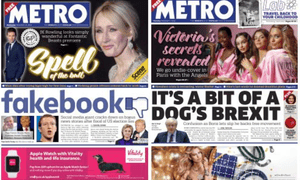 For the first time in ages we see some potentially 'positive' news coming from the circulation of Newspapers. The metro has risen in circulation and has passed the daily mail and is now catching the Sun.